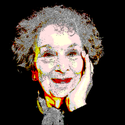
Margaret Atwood
Full Name and Common Aliases
Margaret Eleanor Atwood, often referred to simply as Margaret Atwood, is a name synonymous with literary excellence and profound social commentary. Her work has earned her a place among the most influential writers of the 20th and 21st centuries.
Birth and Death Dates
Margaret Atwood was born on November 18, 1939. As of the latest updates, she is alive and continues to contribute to the literary world.
Nationality and Profession(s)
Margaret Atwood is a Canadian author, poet, and essayist. Her prolific career spans several decades, during which she has established herself as a formidable voice in literature, known for her novels, poetry, and critical essays.
Early Life and Background
Margaret Atwood was born in Ottawa, Ontario, Canada, and spent much of her early childhood in the wilderness of northern Quebec, where her father worked as an entomologist. This unique upbringing, away from the conventional urban environment, fostered a deep connection with nature and a penchant for storytelling. Atwood's early education was sporadic due to her family's frequent relocations, but she was an avid reader and began writing at a young age. She later attended the University of Toronto, where she earned her Bachelor of Arts in English, followed by a Master’s degree from Radcliffe College, Harvard University.
Major Accomplishments
Margaret Atwood's career is marked by numerous accolades and achievements. She has received multiple Governor General's Awards, the Booker Prize, and the Arthur C. Clarke Award, among others. Her work has been translated into over 30 languages, reflecting her global influence. Atwood is also a fellow of the Royal Society of Canada and has been inducted into the Canadian Walk of Fame. Her contributions to literature and culture have been recognized with honorary degrees from various prestigious institutions worldwide.
Notable Works or Actions
Atwood's bibliography is extensive, but she is perhaps best known for her dystopian novel, "The Handmaid's Tale" (1985), which explores themes of power, gender, and identity. The novel has been adapted into a successful television series, further cementing its place in popular culture. Other notable works include "The Blind Assassin", which won the Booker Prize in 2000, and "Oryx and Crake", the first book in the MaddAddam trilogy, which delves into speculative fiction with a focus on environmental and scientific themes. Atwood's poetry collections, such as "The Circle Game", also showcase her versatility and depth as a writer.
Impact and Legacy
Margaret Atwood's impact on literature and society is profound. Her works often address pressing social issues, including feminism, environmentalism, and the complexities of human relationships. Atwood's ability to weave intricate narratives that challenge societal norms has inspired countless readers and writers. Her influence extends beyond literature; she is an outspoken advocate for environmental conservation and women's rights, using her platform to effect change and raise awareness on critical issues.
Why They Are Widely Quoted or Remembered
Margaret Atwood is widely quoted and remembered for her incisive observations on society and the human condition. Her writing is characterized by its clarity, wit, and ability to provoke thought and discussion. Atwood's quotes often encapsulate complex ideas in a way that is both accessible and profound, making them resonate with a broad audience. Her exploration of themes such as power dynamics, freedom, and identity continues to be relevant, ensuring her words remain a source of inspiration and reflection for generations to come. As a result, Atwood's legacy as a literary icon and cultural commentator endures, with her work continuing to spark dialogue and influence contemporary thought.
Quotes by Margaret Atwood
Margaret Atwood's insights on:
What else can I do? Once you’ve gone this far you aren’t fit for anything else. Something happens to your mind. You’re overqualified, overspecialized, and everybody knows it. Nobody in any other game would be crazy enough to hire me. I wouldn’t even make a good ditch-digger, I’d start tearing apart the sewer-system, trying to pick-axe and unearth all those chthonic symbols – pipes, valves, cloacal conduits... No, no. I’ll have to be a slave in the paper-mines for all time.
One and one and one and one doesn’t equal four. Each one remains unique, there is no way of joining them together. They cannot be exchanged, one for the other. They cannot replace each other.
We do not know how we’d behave. But a lot of people facing fascism didn’t become fascists. I don’t happen to believe that we are all monsters.
Vanity is becoming a nuisance, I can see why women give it up, eventually. But I’m not ready for that yet.
Its racist policies, for instance, were firmly rooted in the pre-Gilead period, and racist fears provided some of the emotional fuel that allowed the Gilead takeover to succeed as well as it did. Our.
For drinking Life there are two cups: The No Cup is bitter, the Yes Cup is yummy – Now, which one would you rather have in your tummy?
Nature is an expert in cost-benefit analysis,′ she says. ‘Although she does her accounting a little differently. As for debts, she always collects in the long run...
It isn’t running away they’re afraid of. We wouldn’t get far. It’s those other escapes, the ones you can open in yourself, given a cutting edge.
I try not to think too much. Like other things now, thought must be rationed. There’s a lot that doesn’t bear thinking about.